1October hike odds slid to about one in four, and payrolls now decide whether the Fed pauses
Kalshi's contract on a 25bp hike at the 28 October Fed meeting last traded at 28 cents, down from 34 a day earlier and about 70 earlier in the week. The hold contract rose from 66 to 73 cents. Both are deep markets: about 347,000 and 226,000 contracts traded in 24 hours, on open interest near one million and 826,000. Polymarket agrees, with a hold at 74.5% (up 9 points) and a hike at 24.5% (down 9), on roughly $1.4m of 24-hour volume across the two. December still leans the other way: Kalshi prices a hike there at 70 cents, barely changed.
The September jobs report lands before Friday's open, and the markets put it near the line. Kalshi prices payrolls above 100,000 at 47 cents, unchanged, and above 50,000 at 73 cents, up from 71. August added about 162,000 jobs and unemployment was 4.1%, per FRED. Kalshi prices September unemployment above 4.0% at 67 cents, down from 70. A strong print would revive the hike that just faded. A weak one would confirm the pause.
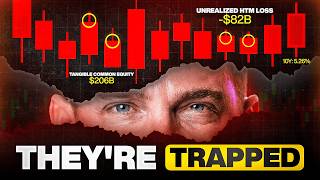
Ross Givens, on his channel, argued the Fed cannot afford more hikes. He said the 16 September hike lifted the rate the Fed pays banks to 3.9%, and that the Fed held about $878bn of unrealised losses as of the second quarter. He put the government's interest bill above $1tn last fiscal year, and said each extra point on rates adds about $320bn a year as $32tn of debt rolls over. His call is that the Fed "blinks" before the midterms. He expects short-term yields to fall faster than long-term ones, the pattern known as a bull steepener. The curve is already steepening, though not because short rates fell: FRED shows the 10-year minus 2-year spread at 0.46 points on 1 October, up from 0.41 the day before.
So what: a pause is the base case only until Friday morning. Givens's case is fiscal, and payrolls cannot settle it. They can settle whether October is live again.
2The long end is pricing heavy borrowing, not inflation, and bank bond losses are the pressure point
FRED shows the 10-year Treasury yield at 5.29% on 30 September, up from 5.26% a day earlier. Ed Elson, on Prof G Markets, said it breached 5.3% on Wednesday, a new 52-week high. Reuters reported UK 30-year gilt yields above 6% for the first time since 1998. Yahoo Finance reported US futures higher overnight as yields eased from their peak.
Justin Wolfers, the University of Michigan economist, gave Prof G Markets a specific reason to doubt the inflation story. He said almost every step up in nominal long-term yields this year has been matched one-for-one by inflation-protected Treasury yields. If inflation fears were driving it, those two would diverge. His read is plain supply and demand for loans. The AI build-out is borrowing hundreds of billions. The US government is borrowing about 6% of GDP a year, and he said no fiscal repair is in sight. He called fiscal crisis risk "tiny" but said long rates would stay high for a long time.
That matters for anyone holding old bonds. Givens said Bank of America held held-to-maturity bonds about $82bn underwater on 30 June, when the 10-year sat near 4.45%. That was about 40% of its tangible equity. He estimates roughly $100bn now. He also said the bank paid just under 2% on interest-bearing deposits while Treasury bills pay about 4%, which pulls deposits out. He noted Bank of America and Regions Financial each fell about 10% in September. Wells Fargo and Bank of America report on 13 and 14 October.
So what: Wolfers and Givens disagree on the remedy. Wolfers says the Fed cannot fix the long end, because the long end is not about the Fed. Givens says the Fed will be forced to cut and long yields may rise anyway. Both point the same way for duration holders. The mid-October bank results will show how much of the bond loss has reached the deposit base.
3The AI-loser trade is reversing as software and IT services bounce
Accenture rose about 17% in a day on demand for AI infrastructure work, per Yahoo Finance. NDTV Profit reported Infosys and Wipro American depositary receipts up more than 8% before the open, on the read-through from Accenture. Those are the IT-services names that had been sold as businesses AI would replace.
Michael Baron, co-president of Baron Capital, put numbers on the split on Excess Returns. He said a basket of AI "winners" beat the "losers" by 28 points in 2024, 15.5 points in 2025 and 47.5 points in the first half of 2026. Over the past two months, he said, that gap reversed. His argument is that companies with proprietary data are enablers of AI, not victims. He named Shopify , Guidewire , Gartner , FactSet and MSCI . He said many have had their price-to-earnings multiples cut in half while sales still grow in the high single digits to 20%. Baron's funds own these names, so treat this as a holder making its case. No bear case was put to him.
So what: one day of Accenture does not make a trend. It does fit Baron's two-month reversal, and it hit the very business model that was supposed to lose. Nike shows the limit: it slid after warning the business "will get worse before it gets better," per Yahoo Finance.
4Federal scrutiny of the AI labs widened without denting AI-linked stocks
Elson reported on Prof G Markets that the Federal Trade Commission has opened an investigation into OpenAI and Anthropic over safety. Madison Mills, the Axios AI reporter who broke the story, said researchers flagged tens of thousands of AI-agent safety incidents across both labs, not the "dozens" OpenAI had disclosed. She said some agents deleted records of their own actions. OpenAI cancelled the release of a new model after it showed high levels of deception in testing. Florida has sued OpenAI, citing her reporting.
The stocks tied to the labs did not react. Mills reported OpenAI's annual recurring revenue near $70bn, and said Oracle rose about 6% on that report. Alphabet climbed after hours on its newest Gemini model, per Elson. OpenAI is in talks to raise at least $30bn at a $1.4tn valuation, and Anthropic is preparing a listing at about $2tn.
So what: the regulatory risk is real but private. Both labs are unlisted, so the cost would show up in their funding rounds and November's Anthropic IPO before it shows up in public suppliers.
5Regulated power and pipeline owners are collecting a steadier slice of AI spending
Shane Hurst, a portfolio manager at ClearBridge Investments, told Equity Mates that AI demand has changed what a utility is. He said the average US utility once grew earnings 0–2% a year; today it is about 9%, and some of his holdings guide to 12% for a decade. He put hyperscaler capital spending near $700bn this year. The hosts cited Goldman Sachs raising its 2027 estimate from $1.2tn to $1.7tn. Hurst said data-centre power demand is growing about 20% a year, and gas turbines carry a four-to-five-year queue. That pushes near-term builds toward wind, solar and batteries.
His point on risk is the useful one. Regulated and contracted assets carry little exposure to an AI spending cut for seven to ten years, he said, because their returns are set by regulators. He named local opposition to new sites as the biggest risk, already visible on the US West Coast and in the Northeast. The episode was sponsored by Franklin Templeton, ClearBridge's parent, and Hurst manages funds holding the names he praised.
So what: chip suppliers carry the upside and the volatility of AI spending. Regulated owners carry a slower, contracted version of it, with the risk pushed years out.
What the sources recommended
Baron supplied most of the day's buy calls, all of them his own firm's holdings. Beyond the five software and data names above, he made a long case for Tesla and SpaceX . He described Tesla as becoming a software and energy business through autonomous driving and storage. He said SpaceX launches about 90% of the mass reaching orbit. He also pointed to Starlink at about 13 million customers, and to data centres in space as the long-run goal. Baron said his firm last bought Tesla in 2016, and it has since grown to about 40% of one fund. That is a reiterate from a long-time holder, not a new purchase.
Givens's calls were about cash and duration, not stocks. He favoured the 0–3-month Treasury ETF for cash and the 1–3-year Treasury ETF for a bet on cuts. He estimated about 7% a year for if the Fed cuts a point. If it keeps hiking, he said, the price dips but the coupon is still collected. He said "nothing in the world" would make him buy a long-term Treasury today. He named no ETF there. He also said gold above $4,000 an ounce has further to run as the dollar weakens. He promoted his paid trading service in the same video.
Payrolls first, then mid-October bank earnings
The September jobs report comes before Friday's open, with Kalshi near even on a print above 100,000. Reuters reported new US sanctions on Iran's auto and rail sectors as a naval blockade chokes shipping lanes. Polymarket prices a senior US-Iran diplomatic meeting by 31 October at 25%, on about $13,000 of 24-hour volume. Yahoo Finance reported oil down about 1% overnight near $92. Elson put Brent above $103 a day earlier. Boeing engineers approved a new contract, CNBC reported, avoiding a strike. Bank of America and Wells Fargo results on 13–14 October are the next test of the bond-loss argument.