Market sentiment indicators: how AlphaDrift reads fear, greed, and cross-asset signals
Individual stock prices can move on company-specific news. But when equities, bonds, commodities, and currencies all move together, something bigger is driving the market. AlphaDrift's Market Pulse tracks these cross-asset signals alongside the CNN Fear & Greed Index to give you a real-time sentiment snapshot — updated daily.
- AlphaDrift's Market Pulse combines the CNN Fear & Greed Index with real-time data across 6 asset classes and 24 instruments — equities, bonds, commodities, currencies, and crypto.
- A Claude AI narrative distils 24 instruments into 2–3 sentences that name the dominant macro theme, the instruments driving it, and the likely cause.
- Market sentiment indicators are context, not trading signals. They tell you whether the market is fearful or greedy, risk-on or risk-off — useful for timing research and understanding what's driving your holdings.
Why market sentiment matters for investors
Market sentiment is the collective mood of investors — whether they're feeling optimistic and taking risk, or fearful and moving to safety. It doesn't appear in any company's earnings report, but it moves entire asset classes in ways that fundamentals alone can't explain.
Consider a day when the S&P 500 drops 1.5%, gold rises 1.2%, and the US Dollar Index strengthens. No single company reported bad news — the move is driven by a shift in risk appetite, perhaps triggered by a geopolitical headline or a hawkish comment from the Federal Reserve. Understanding these cross-asset relationships helps you distinguish between "my stock is down because of the company" and "everything is down because the market is in risk-off mode."
This is where market sentiment indicators become useful. They quantify the mood so you don't have to guess. AlphaDrift's Market Pulse centralises these signals on a single dashboard — instead of checking five different sites for equities, bonds, gold, currencies, and volatility.
The Fear & Greed Index: a composite sentiment score
The CNN Fear & Greed Index is one of the most widely referenced market sentiment indicators. It combines seven separate inputs into a single score from 0 (Extreme Fear) to 100 (Extreme Greed):
- Market Momentum — S&P 500 vs its 125-day moving average
- Stock Price Strength — 52-week highs vs lows on the NYSE
- Stock Price Breadth — advancing vs declining volume
- Put/Call Ratio — options activity: more puts = more fear
- Market Volatility — the CBOE Volatility Index (VIX) vs its 50-day average
- Safe Haven Demand — bond returns vs stock returns
- Junk Bond Demand — yield spread between investment-grade and high-yield bonds
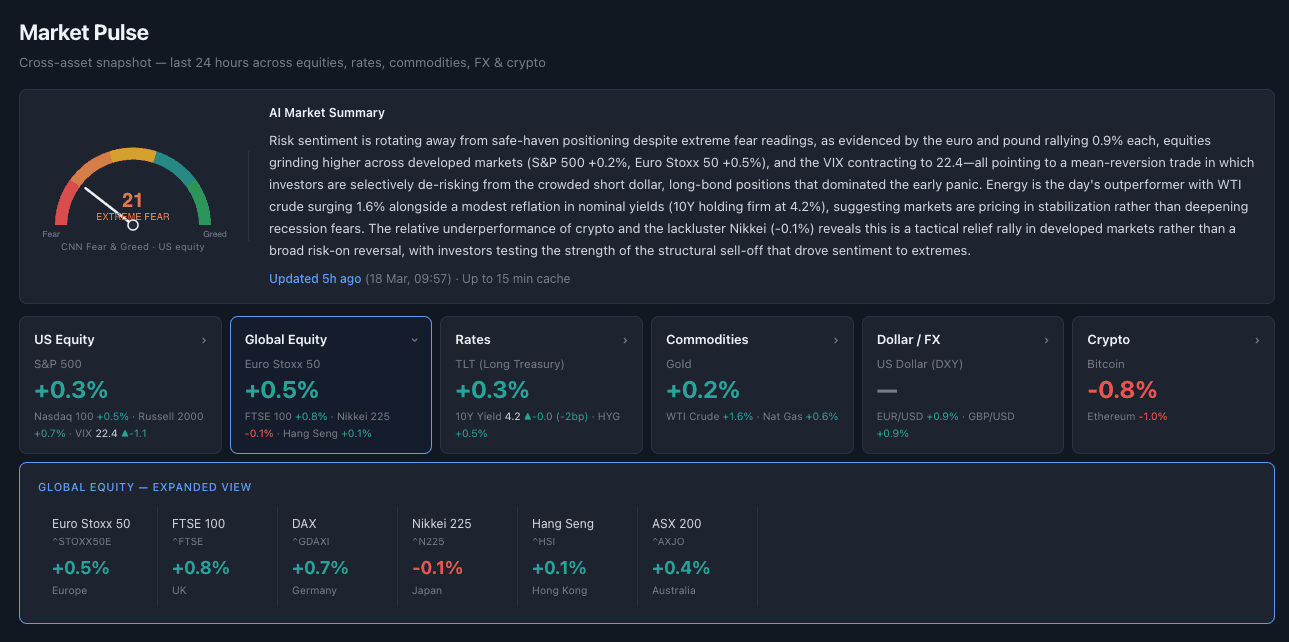
AlphaDrift displays this score as a speedometer gauge on the What's Moving page. The needle position and colour band update daily. Five sentiment bands give you an instant read:
- 0–24: Extreme Fear — heavy defensive positioning; historically, extreme fear readings have preceded some of the strongest short-term rallies
- 25–44: Fear — below-average risk appetite
- 45–55: Neutral — balanced positioning
- 56–75: Greed — above-average risk appetite
- 76–100: Extreme Greed — euphoric positioning; contrarian investors watch for signs of excess here
Contrarian signal, not a timer. The Fear & Greed Index is often described as a contrarian indicator — extreme fear can signal opportunity, extreme greed can signal caution. But "extreme" can persist for weeks. It's context for your research, not a trigger for trades.
Six cross-asset tiles: what AlphaDrift tracks
Below the Fear & Greed speedometer, AlphaDrift displays six expandable tiles — one for each major asset class. Each tile shows a headline instrument with its daily percentage change, plus secondary instruments visible at a glance. Click any tile to expand a detail panel with all instruments in that category. Here's what's covered:
US equity
Headline: S&P 500. Secondary: Nasdaq 100, Russell 2000, VIX. The detail panel adds the Dow Jones. Comparing the S&P 500 (large-cap) against the Russell 2000 (small-cap) reveals whether risk appetite is broad or concentrated in mega-caps — a common divergence in late-cycle markets. The VIX shows as an absolute level (not a percentage change) because a VIX reading of 15 vs 30 carries specific meaning: below 15 is calm, above 25 is elevated, above 35 signals significant stress.
Global equity
Headline: Euro Stoxx 50. Secondary: FTSE 100, Nikkei 225, Hang Seng. The detail panel adds the DAX and the ASX 200. When US equities fall but European and Asian markets hold steady, the selloff may be US-specific rather than a global risk event.
Rates
Headline: TLT (iShares 20+ Year Treasury Bond ETF). Secondary: 10-Year Treasury Yield (level + basis point change), HYG (high-yield bond ETF). The detail panel adds LQD (investment-grade bond ETF). TLT shows as a percentage change because it's an ETF you can trade — its price moves inversely to long-term interest rates. The 10-Year Yield shows as a level (e.g., 4.35%) with basis-point change (e.g., +3bp) because raw percentage changes on yields are misleading: a 3 basis-point move on a 4.35% yield is a 0.07% change, which tells you nothing.
Commodities
Headline: Gold. Secondary: WTI Crude Oil, Natural Gas. Gold often strengthens during risk-off episodes and when real interest rates fall. Crude oil tracks global growth expectations and supply dynamics. Large divergences between gold (up) and oil (down) often signal a market that's pricing in slower growth with monetary easing — a specific macro regime worth understanding.
FX (currencies)
Headline: US Dollar Index (DXY). Secondary: EUR/USD, GBP/USD. The detail panel adds USD/JPY. A rising dollar typically pressures international earnings for US multinationals and can tighten financial conditions in emerging markets. Currency moves are often the first asset class to respond to central bank signals.
Crypto
Headline: Bitcoin. Secondary: Ethereum. Crypto has increasingly correlated with risk assets since 2020. Sharp crypto selloffs that coincide with equity weakness may indicate broad deleveraging. Crypto rallies during equity weakness may signal idiosyncratic demand or a flight from fiat currencies.
The AI market narrative: making sense of the data
Raw numbers across 24 instruments can be overwhelming. AlphaDrift uses Claude Haiku (Anthropic's fast AI model) to generate a 2–3 sentence market narrative that identifies the dominant macro theme driving today's cross-asset pattern.
The AI receives the full cross-asset snapshot — all six tiles plus the Fear & Greed score — and writes a brief summary naming specific instruments and directions. For example: "Risk-off dominated as the S&P 500 fell 0.8% and gold rose 1.1%, driven by hawkish Fed minutes reaffirming higher-for-longer rates. The dollar strengthened 0.4% while TLT dropped 0.6%, consistent with a rates-driven selloff rather than a growth scare."
The narrative names specific instruments and directions rather than vague summaries like "markets were mixed." It identifies causes — a hawkish Fed speech, a surprise payrolls print — not just effects. Learn more about how the AI pipeline works →
How to read the Market Pulse dashboard
The Market Pulse appears at the top of AlphaDrift's What's Moving page, above the sector heatmap and momentum table. Here's a practical workflow for reading it:
- Start with the Fear & Greed score. Is the market fearful, neutral, or greedy? This sets the context for everything else. If Fear & Greed is at 22 (Extreme Fear), the red numbers you're seeing in your portfolio are likely market-wide, not company-specific.
- Scan the six tiles. Are most tiles red (risk-off day), most green (risk-on day), or mixed? A mixed day — equities down but gold and bonds up — tells a different story than a day where everything is falling (liquidity crisis) or everything is rising (broad optimism).
- Read the AI narrative. It synthesises the cross-asset pattern into a causal explanation. Use it to confirm or challenge your own reading of the data.
- Then scroll to the sector heatmap. Now that you know the market's overall mood, the heatmap shows you which sectors are outperforming or underperforming relative to that mood. A sector that's green on a red day is showing relative strength — that's notable.
Update frequency: The Market Pulse refreshes daily after the US market close (4:15 PM EST), with additional intraday price updates at 10:30 AM and 4:15 PM AEST. The CNN Fear & Greed score updates continuously during market hours. View the full schedule on the Data page.
What market sentiment indicators cannot tell you
Sentiment indicators are powerful context, but they have clear limitations that every investor should understand:
- They don't predict timing. Extreme fear can persist for weeks before a reversal. Extreme greed can run much further than expected. Sentiment tells you the market's mood — not when it will change.
- They're backward-looking snapshots. The Fear & Greed Index and cross-asset prices reflect what has already happened, not what will happen next. A VIX spike tells you the market is stressed now, not whether it will be stressed tomorrow.
- They don't replace fundamental analysis. A sector with strong macro fundamentals can still be a poor investment if it's wildly overvalued. Sentiment context is one input alongside valuation, earnings, and macro outlook. AlphaDrift's Opportunity Score combines sentiment context with fundamental scoring for this reason.
- Correlation patterns break. "Gold goes up when stocks go down" is a generalisation, not a law. In a true liquidity crisis, everything sells off together. In a disinflationary environment, both bonds and stocks can rally simultaneously. Historical correlations are guides, not guarantees.
AlphaDrift is an informational tool, not a financial adviser. Market Pulse data and the AI narrative are designed to help you understand current conditions — not to recommend trades. Always conduct your own research and consult a qualified financial adviser before making investment decisions.
Frequently asked questions
What is the CNN Fear & Greed Index and how does AlphaDrift use it?
The CNN Fear & Greed Index is a composite score (0–100) that combines seven market indicators — including the VIX, put/call ratio, junk bond demand, and market breadth — into a single sentiment reading. AlphaDrift displays it as a speedometer gauge on the What's Moving page, updated daily, alongside cross-asset data and an AI narrative for context.
How many instruments does AlphaDrift's Market Pulse track?
The Market Pulse tracks 24 instruments across six asset classes: US equities (S&P 500, Nasdaq 100, Russell 2000, Dow Jones, VIX), global equities (Euro Stoxx 50, FTSE 100, DAX, Nikkei 225, Hang Seng, ASX 200), rates (TLT, HYG, LQD, 10-Year Yield), commodities (gold, crude oil, natural gas), currencies (DXY, EUR/USD, GBP/USD, USD/JPY), and crypto (Bitcoin, Ethereum).
What does the AI market narrative do?
The AI narrative uses Claude Haiku (Anthropic's fast AI model) to read the full cross-asset snapshot and write a 2–3 sentence summary identifying the dominant macro theme driving today's moves. It names specific instruments and directions rather than giving vague summaries.
How often does the Market Pulse update?
The full Market Pulse (cross-asset data + AI narrative + Fear & Greed score) refreshes daily after the US market close at approximately 4:15 PM EST. Yahoo-only price updates run at 10:30 AM and 4:15 PM AEST on weekdays. The CNN Fear & Greed score itself updates continuously during US market hours. All timestamps are visible on each page.
Should I use sentiment indicators to time my trades?
Sentiment indicators are context, not timing signals. An Extreme Fear reading means the market is fearful now — it doesn't predict when the reversal will happen. Use sentiment alongside fundamental analysis and sector opportunity scores to inform your research, not as a standalone trigger for buying or selling.