1The case against a December hike now runs through the AI sell-off, and the market has not moved
Peter Boockvar, on Excess Returns, makes the sharpest argument of the weekend. Kevin Warsh said at the October press conference that he is watching CoreWeave and other AI names' cost of funding. Boockvar reads that as the Fed admitting the data-centre build-out now sits inside its reaction function. If the AI trade keeps rolling over into December, his view is that the Fed does not hike at all. And if it does hike, he expects that to be the last one.
The market disagrees, and by a wide margin. Kalshi prices a 25bp December hike at 77%, up a point on the day, on $33k of 24-hour volume and $842k of open interest. Polymarket sits at 76.5% on $147k of daily volume. October's labour data underpins that pricing: FRED shows payrolls up 165,000 to 159.29m and unemployment down to 4.1% from 4.2%. Further out, Kalshi has January at 74% for a hold, so it prices one more hike, not a cycle. That part matches Boockvar's "tweaking around the edges" view.
So the split is narrow but real. Both camps expect the hiking to stop soon. Boockvar thinks the AI sell-off ends it before December; the market thinks strong jobs carry one more. Tuesday's October inflation print is the first thing that could move it. Kalshi puts headline monthly inflation above 0.2% at 65% and above 0.3% at only 15%. A soft print would hand Boockvar's argument its first data point.
2Stocks are pricing peak AI capex before it arrives, and the neoclouds' debt is where it shows first
Boockvar's core point is about rate of change. Hyperscaler capex is set to rise to roughly $1.2 trillion in 2027 from about $800 billion. He argues stocks trade the slowing of that growth, not its level, so they are front-running a 2028 fall-off. He adds a supply problem: new DRAM and NAND capacity lands in 2028–29 just as demand growth peaks. On , he says calling it cheap at six times earnings misreads a cyclical. At the June peak it traded near 10 times sales, the same multiple as its 2000 top.
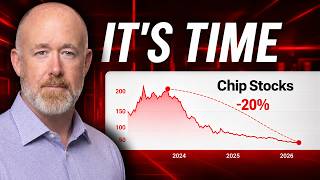
The stress is clearest in credit. Boockvar says 's five-year credit default swaps trade near 1,200 basis points, which he reads as roughly a 60% implied default probability. Meanwhile the equity still carries a $25–30 billion market cap. He contrasts its leased-building model with , which owns its sites, and with 's stronger balance sheet. Equity Mates' monthly update tells the same story from Australia: NextDC fell 42% in a day after failing to connect a Melbourne site to power, and the Firmus IPO was pulled. Boockvar adds that the Anthropic listing is now talked about near $1.2 trillion, down from $1.5 trillion. Polymarket is more generous: it puts a closing market cap under $1.25 trillion at just 15.7%, with the $1.25–1.75 trillion range at 63% on about $63k of daily volume.
The dip-buyers have not left. The presenter of Business with Brian lays out a ten-name chip list he bought into on Thursday's drop. He cites 15 single-day S&P falls of 4% or more in 30 years, with buyers on the day up a year later 12 times out of 15. A Compound and Friends short dares the bears to back their view by buying a fund built to fall: the Roundhill neocloud ETF, already 44% below its high. CoreWeave reports on Tuesday after the close, which tests the credit-market reading directly.
3Oil's war premium is fading on diplomacy, but the supply hole behind it is two years deep
The news flow over the weekend pointed one way. Reuters reports oil fell after the President said new Iran strikes were "unlikely" if talks progress. Iraq says it has reached understandings with Washington to export through Hormuz. Gold rose over 1% in Asia as softer oil eased inflation worries. Lower oil feeds straight into the inflation print the Fed is watching, which loops back to claim 1.
The prediction markets did not follow. Polymarket's US–Iran ceasefire by 30 November fell 7 points to 56.5%, on $53k of daily volume. A senior US–Iran meeting by 30 November fell 11 points to 16.5%, on $136k. The President's own Sunday post stressed the blockade, not talks: "very little gets into, or out of, Iran." So the headlines and the money disagree on direction. Watch the meeting market as the cleaner read.
Boockvar's point is that even a deal does not refill the tank. Citing Saudi Aramco's results, he says about 3 billion barrels failed to transit since March. Pipelines covered about 2 billion and inventories the rest. Aramco estimates two years to normalise even if the strait fully reopened today. He also cites commodity investors Goehring & Rozencwajg's view that US shale is plateauing. His conclusion is that a peace-deal drop in oil stocks is one to buy into, not a top. That is his view of the cycle, and it is worth noting he runs energy holdings.
4As the AI trade cracks, the case for the unloved corners is being made again
A Yahoo Finance chart of the day notes tech now trades cheaper than the S&P 500 for the first time since 2017. Boockvar's answer is to look elsewhere. He calls consumer staples and healthcare "troughing" and owns . Abroad he owns , and , plus Singapore, Vietnam, Brazil and India. His mechanism links back to claim 2: the world is long US tech, so an AI unwind should weaken the dollar. A weaker dollar helps non-US assets and gold, where he sees central banks still buying.
Equity Mates' hosts lean the same way on healthcare. Their best performers were Eli Lilly, Spotify and Pro Medicus, and one host is still building after a 22% revenue quarter. Their caution sits elsewhere: Alphabet's search growth slowed to 12% from 17%, and fell 25% on a leaked memo about spinning out its fintech arm. One host says he would sell if the spin-off happens, so it is a conditional view, not a call. Sea reports on Tuesday before the open.
What the sources recommended
Sixteen single-name calls came from three videos, and ten of them are one list from one presenter. Business with Brian named , , , , , , , , and as his dry-powder list after Thursday's sell-off. He bought , and himself, but did not add because it is already 12% of his portfolio. He weights the list 70% large caps, 25% mid caps and 5% small caps. On he flags falling margins as the risk to watch. On he flags that a third of sales come from China. He left and off on purpose, because of debt and a lack of real revenue.
Peter Boockvar's buys are defensive and mostly overseas: , , and . He calls staples "troughing" but warns they are "beaten down for a reason". Equity Mates' is a position one host is still adding to. The one sell is Boockvar on . He frames it as a question rather than a short: why own equity when credit prices a 60% chance it is worth zero?
Tuesday tests two of these claims at once
Tuesday brings October CPI before the open and CoreWeave's results after the close. The first tests the hike pricing in claim 1. The second tests the credit-market reading in claim 2. Monday's reports from and touch power demand and oil, and Sea reports Tuesday morning. Thursday brings and , plus Nebius, a second read on the AI supply chain before Nvidia on 17 November. The Anthropic IPO is next: Polymarket gives an IPO by 30 November an 82.5% chance, with 20 November the most-backed single date.