1The market bought divided government and sold the data-centre buildout
Democrats won both the House and the Senate on Tuesday. The Dow had its best post-midterm day in 44 years, CNN Business reported, and CBS called it the Dow's biggest gain of the year. Ed Elson, on Prof G Markets, puts the Dow up about 3%, its best day since April 2025, with the S&P 500 and Nasdaq each up about 2%. Catherine Rampell, of The Bulwark, gives the usual reason on the same show. A Democratic Congress can take back tariff authority, so policy should become less erratic. Ross Givens makes the same case on his channel: the market wants gridlock, because certainty is bullish.
Underneath the index, the money moved against the AI buildout. Reuters reported data-centre stocks sliding while the major indexes rallied, and Yahoo Finance reported renewables rising on the result. On Prof G Markets, Elson says CoreWeave and Oracle ended the day deep in the red. Apple , Alphabet , Amazon , Microsoft and Meta added nearly $1 trillion between them. Memory makers fell hardest. 24/7 Wall St. reported SanDisk down 9%, with Micron and Western Digital down 7%. Moomoo had Seagate down more than 4% before the open. Stocktwits reported Micron at a three-month low overnight, after a senior Democrat called for AI regulation and a pause in development.
The vote itself explains the split. Exit polls cited on Prof G Markets show 56% of voters called AI and data centres a crucial or major factor. Rampell counts more than 30 local measures restricting data centres passing, against one that eased them. Alex Bores, a New York State Assembly member, cites about 41 local referenda with only one in favour of data centres. He argues most are pauses until rules exist, not bans. Elson reads the day's trade as a bet that the buildout gets curbed while big-tech profits are not regulated. Bores disputes that this is what voters asked for. The so what: the sell-off landed on the companies that build and lease the capacity, not on the platforms that rent it.
2Oil's fall is a bet the Iran war winds down, and the Strait of Hormuz is already testing it
Oil fell hard on the result. Elson cites Brent down about 8% to near $95. WTI closed at $99.64 on 3 November, down from $107.56 on 30 October, FRED data show. Reuters headlined "Oil tanks, stocks leap on US midterms" and reported Vice President JD Vance repudiating the Iran war after the defeat. Rampell links the two directly. If the administration blames the war for the loss, the odds it winds the war down go up.
She is not sure it can be done. Iran now knows it can control the Strait of Hormuz, she says. Overnight, Reuters reported Iran's Revolutionary Guard saying two tankers and a tugboat caught fire in the Strait, and a separate Reuters item had oil rising as investors weighed the war. Yahoo's crude quote was also higher overnight, at about $88.59 for December. The same day, the US sanctioned Indian and Turkish firms for aiding Iran. Indian shares neared three-month highs on cheaper oil, Reuters reported. The so what: oil's fall prices a political intention, and only an actual reduction in Gulf disruption keeps it there.
3A December rate hike got more likely after the vote, not less
Kalshi now prices a 25 basis-point hike at the 9 December Fed meeting at 80%, against 72% on election morning. A hold trades at 22%. The contract carried about $63,000 of 24-hour volume on the hike side, with $448,000 of open interest. Looking past December, a January hold is priced at 80%, up from 71%. The market expects one more hike and then a pause. The fed funds rate averaged 3.88% in October, up from 3.75% in September, FRED data show. The ten-year Treasury yield closed at 4.95% on 3 November. The gap between ten- and two-year yields was 0.32 percentage points on 4 November.
Two guests on Excess Returns frame the same backdrop in opposite ways. John, an ETF veteran who runs the ROE and GQQQ funds, closed his equity overweight months ago. He cites a Fed that "wants to hike", the Iran war, and record ETF inflows of more than $1.5 trillion this year. He calls the period closer to the 1970s than the 1990s. Michael Howell, of CrossBorder Capital, argues global liquidity growth peaked in late 2025. He says markets sit between speculation and turbulence, a regime where long government bonds are the best asset, and he sees long yields topping out around 5.5% to 6%. Both episodes were recorded before the vote. Neither guest squares a hiking Fed with the day's equity rally. That tension is unresolved: stocks priced lower policy risk while rates priced more tightening. Reuters also reported the Bank of England poised to raise rates today for the first time in three years. The so what: a second hike is the pricing, so any relief from cheaper oil has to show up in inflation data before it reaches the rate path.
4AI's financing bill is growing faster than its revenue
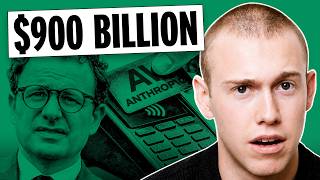
Anthropic's amended IPO filing, discussed on Prof G Markets by John Foley of the Financial Times' Lex column, shows third-quarter revenue of $17 billion. That is twelve times a year earlier. Quarter-on-quarter growth slowed to 47%, from 144% in the second quarter. Compute costs rose from $5.6 billion to $9.9 billion over the same quarter, roughly 80% growth. The filing discloses about $895 billion of compute and data-centre commitments, with about $70 billion due within 12 months. Foley cites Blackstone telling investors it now expects a high-junk credit rating after the listing. His worry is that buyers will treat Anthropic as a scarcity play and look past those numbers.
The wider AI complex is borrowing too. Deirdre Bosa cites Bank of America forecasts of about $655 billion of AI-linked debt this year and about $1 trillion in 2027. Michael Batnick and Ben Carlson, on Animal Spirits, note that Amazon, Alphabet, Meta and Microsoft turned free-cash-flow negative combined for the first time. They also count $131 billion of leveraged loans priced below 80, the most since May 2020. The bull case rests on earnings. Batnick says forward S&P earnings estimates rose from about $270 to $413 in under two years, so he reads the sell-off as healthy. Tom Lee, of Fundstrat, told Prof G Markets the Nasdaq correction is ending. He forecasts at least a 15% rally in the Nasdaq 100 and the S&P 500 at 8,200 to 8,400 by year-end. The so what: the bulls argue from earnings and the bears from funding, and the next large AI debt sale is the test of which side is right.
What the sources recommended
Only five single-name calls came out of fourteen videos, all from two people, and four of them are positions the person already holds. Ross Givens disclosed buying 500 shares of EchoStar near $100. His case is a sum-of-the-parts estimate of about $40 billion against a market value near $29 billion, mostly SpaceX shares owed to EchoStar plus cash. His caveats are large: those shares arrive only at a deal close targeted for late 2027, the cash figure is unaudited, and no bid for the whole company has been reported. Givens also reiterated two positions held by his paid service. Hinge Health was bought near $94 to $95 and is up about 30%. Rapid7 was bought at $14 and is retesting its breakout level. He flagged Check Point , Gilead , Eli Lilly and AbbVie as breakouts, without a stated entry. Each video promoted his paid membership.
Owen Rask, at the Equity Mates FinFest conference, said he personally owns iShares S&P 500 , listed in Australia. His community portfolio holds Vanguard's Australian high-yield ETF , which he says beat the broad Australian index by about 10% over one year. He attributes that to higher rates, and the window is a single year. No source made an explicit sell call. Batnick did say Reddit will "never make another all-time high", but he named no trade.
The next tests arrive within a week
Airbnb, Cloudflare, Affirm, DraftKings, Atlassian, Lyft, Microchip and EOG report after today's close, with ConocoPhillips, Duke Energy, Zoetis and Ralph Lauren before the open, on Finnhub's calendar. Cloudflare and Microchip are early reads on whether the data-centre sell-off reaches companies that sell into it. ADP's October count rose by about 86,000 jobs, FRED data show, ahead of the government's October jobs report. Givens expects EchoStar's third-quarter results around 9 to 12 November, unconfirmed. Felix Prehn flags the 11 December government funding deadline as the next point of shutdown risk. If oil holds near $95 and the December hike odds still climb, the rally is running on divided government alone.