1Treasury yields at a two-decade high are narrowing the rally to five stocks and stalling new listings
FRED puts the 10-year Treasury yield at 5.28% on 2 October, up from 5.24% the day before. Yahoo Finance showed it at 5.31% early Tuesday. Ed Elson, on Prof G Markets, noted the 10-year touched 5.3% and the 30-year passed 5.6%, both the highest since 2002. Higher risk-free returns raise the bar every stock has to clear. That lowers the multiple investors will pay.
The effect shows up in who is still rising. Elson said Microsoft , Meta , Apple , Alphabet and Nvidia supplied 93% of the S&P 500's gains since July. He added that more than half of the index's members are down 20% or more from their highs. The Nasdaq still closed at a record on Monday. Yahoo Finance reported Nvidia at an all-time high and AMD crossing $1 trillion in value.
New listings are where the strain is clearest. Elson counted six companies that postponed their debuts, including the smart-ring maker Oura, Holtec and SB Energy. Most cited market uncertainty. Steve Johnson of Forager Funds, on Equity Mates, gave the mechanism: borrowing for AI build-outs now costs six or seven percent rather than three or four, and the capital flowing into AI is drawing money out of bonds and everything else.
Elson's response was to buy Treasuries. He expects the bond sell-off to end within weeks. Scott Galloway said he has never owned a bond and is now looking at them.
The rate outlook is genuinely split. September payrolls rose by 29,000, per FRED, and unemployment ticked up to 4.2% from 4.1%. Yahoo Finance read that as easing the case for an October hike. The prediction markets moved the other way over the past day. Kalshi prices an October hike at 21 cents, up from 18, on about 67,000 contracts. Polymarket has it at 19.5%, up three points, on about $296,000 of volume. Kalshi's December hike contract rose to 75 cents from 70.
So what: weak hiring argues for patience, while sticky prices keep hikes in play. Until a soft inflation print settles it, high yields stay the dominant force. That pressure falls hardest on the stocks outside the largest five.
2Software with proprietary data was sold as an AI loser, and the first takeover bid has started the re-rating
Michael Baron of Baron Funds, on Excess Returns, argued the market has painted software with one brush. In his view, companies that own deep proprietary data cannot be replaced by a general AI model. They are the channel through which customers will use AI. He named Shopify , with 3.5 million merchants and 20 years of their data, and Guidewire , which serves insurers. He also named Gartner , FactSet and MSCI . He said many of these have seen their earnings multiples halve while growth runs from high single digits to about 20%. Baron's funds hold them, so this is a holder's case, not a fresh pick.
Johnson made a narrower version of the argument. The software he wants is cheap and sticky. His example was accounting software that costs a small firm about $150 a month but runs payroll and tax. He said US software has already recovered much of its fall, while Australian names are still near their lows. He still cannot make the valuation work for the accounting-software maker Xero .
Monday's tape lined up with the thesis. Yahoo Finance reported that Schneider Electric's $22.6 billion bid for PTC lifted software stocks. Per Finnhub quotes, Guidewire rose 7.3%, Shopify 5.8%, FactSet 3.9% and MSCI 3.1%.
So what: a takeover is the cleanest test of whether a sold-off business is mispriced. One bid supports the read-through to other data-rich software. It does not show that AI pressure on the sector has passed.
3Anthropic's reported loss is mostly an accounting charge; its compute commitments and customer concentration are the real exposure
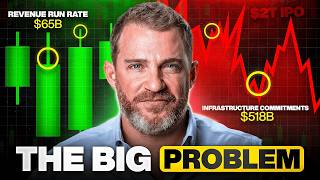
Reuters reported on 28 September from Anthropic's confidential filing that the company lost $42 billion last year on $4.6 billion of revenue. Ross Givens, on his channel, broke that figure down. He said about $34 billion is a non-cash charge. It arose because financing owed in shares grew far more valuable as the company's valuation rose. The operating loss was closer to $8 billion, with $7.33 billion spent on computing power.
The trend since then is steep. Citing figures reported by Bloomberg and the Financial Times, Givens said second-quarter revenue topped $11.5 billion, against $787 million a year earlier. He said the quarter showed a profit of about $559 million. Those numbers are not yet audited.
Givens said the number to worry about is $518 billion of committed spending on cloud computing and infrastructure. Two customers made up about a quarter of 2025 sales, and many large customers are not on long contracts. Galloway, on Prof G Markets, called that concentration the most frightening part of the filing for a company seeking a valuation of up to $2 trillion. He said he has told people holding shares in Anthropic or OpenAI to sell in private markets now. Elson flagged the Federal Trade Commission's new investigation into both companies over safety and consumer protection.
Polymarket prices an Anthropic listing by 30 November at 67.5%, up six points, on about $8,200 of 24-hour volume. Its most likely closing market value is the $2.0–2.25 trillion band, at 31%. Givens's test is the public prospectus, which must carry audited 2026 figures. He also pointed to SpaceX , which listed in June at $1.77 trillion and later halved.
So what: the headline loss tells little about the business. Whether quarterly revenue is still climbing past $11.5 billion while those commitments ramp tells a lot. That answer arrives with the public filing, not before.
4Diesel is pushing inflation up through freight charges that interest rates cannot reach
A chemical engineer who models refineries, and who runs the nonprofit site Data for the People, argued on Excess Returns that diesel is now a direct inflation input. Diesel sets fuel surcharges on trucks and railways, with up to a two-month lag on rail. He estimates fuel is now 26% of truckload costs. Diesel held at $7.84 a gallon for a year would add 0.46 to 0.65 points to consumer prices, depending on how retailers pass it on. He put the hit to grocery prices at 1.5–2%. His point is that monetary policy has no lever on this, and that the chain may continue even if the Iran war ended tomorrow.
The President made a related case in a Monday post. He said gasoline prices are now driven less by the Strait of Hormuz than by refining capacity, citing Ukrainian strikes on Russian refineries and closures in California. Reuters reported that G7 countries agreed to release diesel and oil stocks, and the IEA said oil prices had started to fall. Yahoo Finance had crude at $89.39 early Tuesday.
Kalshi expects September inflation to rise from August's 3.35%. Its contract on year-on-year inflation above 3.6% trades at 43 cents, up from 41, on about 10,500 contracts. Above 3.5% sits at 84 cents.
So what: a stock release can cap crude, but refinery bottlenecks keep diesel tight. If freight costs keep feeding goods prices, the Fed faces inflation it cannot cool through demand.
What the sources recommended
Baron's five software names, , , , and , came as a holder's argument that the sell-off went too far. On Equity Mates, Johnson called Catapult , the Australian sports-analytics firm, his biggest holding and the stock he sleeps best on. He bought back in after selling out near the top. It trades at about four times revenue, he said, with pricing power still unused. He also described Motorcycle Holdings at about 6.5 times earnings with a 7% dividend yield. He attached a clear caveat: it is a small, illiquid position, and he does not want listeners rushing in. Both trade on the Australian exchange.
On the other side, Galloway said holders of Anthropic should sell in private markets. Elson said he is "still not touching" at 38 times earnings until the new chief executive produces a new growth product. Galloway, who has owned Apple since about 2009, predicts its smart-home hub due 13 October will succeed. Johnson called the planned Australian listing of the AI data-centre builder Firmus "the epitome of bubble-like behaviour".
Fed minutes and Anthropic's investor meetings frame the next fortnight
Minutes of the Fed's September meeting land this week, per Yahoo Finance and Prof G Markets. They will show how many officials want more hikes. Earnings are light: Constellation Brands reports Tuesday after the close, Levi Strauss on Wednesday, PepsiCo on Thursday morning and Delta on Friday, per the Finnhub calendar. Apple's smart-home event follows on 13 October, and the September inflation report on 14 October. Givens said Anthropic begins investor meetings the same day.