1Crude eased and diesel set records, so the half of the energy shock that feeds inflation did not ease
Monday's energy tape looked like relief. The United States Oil Fund closed down 3.68%, the Brent-tracking down 2.81%, and the energy sector down 2.88%. Reuters had marked Brent down to $100 on Sunday on hopes of US-Iran diplomacy and a partial recovery in Saudi exports, after China pressed Iran to rein in Houthi attacks on Saudi oil facilities. Falling crude was one of the three reasons the equity rally was handed on Monday morning.
The refined-products market went the other way on the same day. Reuters reported global diesel prices at record highs, with further rises possible, and in a separate piece that the global diesel shortage is likely to last into 2027 as storage tanks drain. Bloomberg put US diesel above $6.50 a gallon. The distinction matters because a household and a freight operator do not buy crude. They buy the refined product, and that is what lands in the headline inflation print.
The supply damage behind it is physical and slow to reverse. President Trump posted on Monday that Russia "has unfortunately lost control of its Diesel Oil Industry due to its War with Ukraine", and that a large number of its diesel refineries "have been blown up and are, at least temporarily, out of commission". Reuters separately reported that Hormuz shuttles are keeping oil flowing but at a high cost, and that LNG buyers are seeking greater supply diversity because of the Iran war. Crude can be re-routed. Refining capacity has to be rebuilt.
The prediction markets priced the crude leg, not the diesel leg. Polymarket's September WTI ladder — deep at $320k of 24-hour volume inside an event carrying $1.34m of liquidity — marked the "hits $110" leg down 4.0 points to 5.5% on the day and marked the "falls to $80" leg up 2.5 points to 8.5%. That is a distribution shifting lower, not a market bracing for a spike. Its thin sibling disagreed: the contract on any US state seeing gasoline below $3.75 a gallon on 30 September fell 10 points to 27.5%, on $273 of volume, so treat the direction as a hint rather than a price.
The geopolitics turned overnight in the escalatory direction. CNBC reported oil rising on Tuesday after Treasury Secretary Scott Bessent said all Iranian airlines would be shut down from Wednesday; the G7 foreign ministers called on Iran to stop arming the Houthis; and two Republican Senate candidates broke with the President to call for a swift end to the Iran war. Yet Polymarket's diplomacy ladder rose on every leg. A US-Iran diplomatic meeting by 31 October is priced at 32%, up 4.5 points on the day and 12.5 points on the week, on $87k of 24-hour volume — the deepest leg in the event. The contract on the meeting happening in the United States rose 3.9 points on the day and 14.75 on the week to 14.9%, which fits a week in which the President is at the UN General Assembly with Iran on the agenda. The contract on a full Iranian airspace closure by 30 September fell 2.5 points to 4.0% on $24k of volume, so the market read the airline shutdown as pressure rather than as a step toward closure.
So the headlines and the odds are pointing in opposite directions, and only one of them is a price. The escalation is in the news; the diplomacy is in the book. Either way, a deal returns barrels and does not rebuild a refinery, so the diesel squeeze is the part of this that outlives the negotiation.
2The rate argument has moved from whether to how far, and the curve flattened as it did
The decision is in the data now, not just the commentary. The Fed's target range moved from 3.50–3.75% to 3.75–4.00% effective 17 September, and the effective funds rate printed 3.88% against 3.63% the day before. Ed Elson, on Prof G Markets, recorded it as the first increase since 2023 and noted that Kalshi had the odds of a hike at 88% going into the announcement.
Both venues now price the follow-up meeting the same way. Polymarket's October event — $1.01m of 24-hour volume and $2.21m of liquidity — has a 25bp hike at 53.5% against no change at 45.5%, with the cut legs at 0.55% and 0.25%. Kalshi's October contracts last traded at $0.54 for the hike and $0.46 for the hold, on 345,267 and 440,741 contracts of open interest. Two independent books, two points apart. Beyond October, Polymarket prices another hike at some point in 2026 at 86.5%, and the two-hike leg of the count market at 60.5%, up 19.5 points on the week.
The day's marginal move was faintly the other way. The three-hike leg fell 5.65 points to 20.75%, the one-hike leg rose 2 points to 15.5%, and the October hold leg rose a point. Treasuries agreed: closed up 0.68%. That is a day of shaving the hawkish tail, not a change of direction.
The argument against the hike is a supply-shock argument, and Elson put it plainly while saying he disagreed with it: the inflation comes from the war in Iran and from oil that cannot get out of the strait, so raising rates slows the economy without touching the cause, and it pushes 30-year mortgage rates — already above 7%, the highest in over a year — higher still. Scott Galloway took the other side, arguing the decision was the right call and that the value of an independent central bank is precisely that it resists the person who appointed its chair. The President criticised the board while pointedly leaving Chair Kevin Warsh out of it.
The printed numbers are why the hawks won the vote. Headline CPI rose 0.40% in August, to 334.131 on the index, which is about 3.35% year over year. Polymarket's September core CPI market — thin at $13k of 24-hour volume — has the modal outcome at 2.4% (43.5%) with 2.5% at 32%. A percentage point of daylight between headline and core is the energy component from claim 1, arriving in the inflation statistic.
The curve's answer is the most interesting part. The 10-year sat at 5.01% on 18 September and the 2-year at 4.76%, and the 2s10s spread compressed to +0.20 on 21 September from +0.33 on 15 September. The front end rose faster than the long end through the hike. That is the shape of a market that expects the tightening to reach growth before it reaches inflation.
3A crowded short sits under the 10-year note just as the duration case is turning
David Rosenberg, on Excess Returns, described raising 10% cash and expecting to keep de-risking, and said his firm's bond-duration model is now about as bullish as it was in October 2023 — the last time, in his telling, you held your nose and extended duration, and it paid. The positioning number he cited is the reason he expects the move to be violent rather than gradual: roughly 280,000 net speculative short contracts on the 10-year note on the board of trade. "If they were forced to cover," he said, "we're going to get the mother of all short-covering rallies in the Treasury market."
Two caveats travel with that call and both come from the same interview. Rosenberg said the duration extension is what the next big move "might" be, not what he has already done — so it is a stated intention, not a position. And Jack Forehand pushed back on the permabear label by pointing out that Rosenberg runs 50% equities, just not S&P-shaped equities, which makes him roughly a conventional balanced investor rather than a bear.
Forehand also named the company Rosenberg is keeping: Jim Paulsen is bullish on bonds, Andy Constan has just turned bullish, and Jared Dillian is positive. That is four voices, and the honest caveat is that all four came through one podcast network's guest roster in one week, so it is a sample of who was booked rather than a survey of who is positioned. Rosenberg's own count of the short base is the harder evidence, and it is unverified here.
A crowded short is a condition, not a catalyst. It changes the shape of the move if yields fall; it does not make them fall.
4The best session since early August was three stocks wide
Monday's index numbers were good and the breadth underneath them was not. closed +1.55% at 773.50 — its strongest day since early August — while the Nasdaq-100 proxy rose 2.78% and the small-cap managed 0.52%. A 2.26-point gap between the large-cap tech complex and small caps in a single session tells you who did the work.
The names did it. rose 11.34% to 741.25, 17.16%, 12.14%, 9.95%, 5.38% and 2.30%. Reuters attributed the session to AI optimism reigniting as Treasury yields retreated; CNBC's read on the chip leg was that Meta's new agent product revived demand expectations for CPUs.
Elson, on Prof G Markets, made the Meta case directly and disclosed his position: he bought in June at $564 a share and is up around 20%. His argument is a valuation one. Meta's new consumer agent, Muse, shipped on 8 September and has added roughly $170bn of market value since, taking the stock up 14% over the month against an S&P down 2% — and it still trades at about 25 times earnings, below the index, against Microsoft at 28, Alphabet at 32, Amazon at 32 and Apple at 38 on his adjusted basis. Both of those multiples check out: 's trailing price-to-earnings is 24.9 and 's is 38.3. Elson called a sell at that level.
Galloway's version of the same argument is about the input rather than the multiple: Meta's lead is first-party data across roughly four billion monthly users, compute can be bought and that data cannot. He also noted he had predicted Meta would be the most important AI company of 2025 and got the timing wrong by a year, which is the kind of disclosure worth keeping attached to the call.
Jim Paulsen's earnings work, relayed on Excess Returns, is the structural version of Monday's breadth problem. He splits the S&P's forward earnings three ways: technology and telecoms, just under half of market cap, soaring; energy and commodities, only about 5% of cap, up enormously because oil went up; and the remaining seven sectors up about 6% annualised year to date, which after 3.5–4% inflation is roughly 2.5% real. His point is that the aggregate hides it. "If it was just those seven sectors, no one would be saying earnings are great."
Rosenberg supplied the demand-side counterpart. Employment growth over the past year has been "practically" nil and real disposable income growth with it, yet consumer spending is running above 2%. The gap is funded by the savings rate falling from a pre-Covid norm of 8% to about 3%, by credit-card balances he called "a source of desperation" rather than strength, and by an equity wealth effect he puts at a 90% correlation with consumption now that household net worth relative to disposable income has hit a new high. His conclusion is conditional and dated: if the market wobbles more than it has and the labour market does not re-heat, the consumer runs into trouble as 2027 arrives.
Which is the uncomfortable loop. The index is carried by a handful of AI names, the consumer is carried by the wealth effect from those same names, and seven sectors out of ten are growing earnings at roughly the rate of inflation.
5The coverage gap between technology and healthcare desks is where the gene-editing names sit
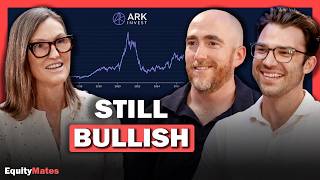
Cathie Wood, on Equity Mates, was asked what the next NVIDIA is and answered healthcare, with a mechanism rather than a hunch. Technology analysts avoid healthcare because it is slow, regulated and hostage to insurers and governments; healthcare analysts will not run at it the way a technology desk runs at a new platform. So, in her framing, the part of the market where AI meets biology is the most inefficiently priced, because the coverage that would price it falls between two desks.
Her two named examples are and . She pointed to beta-thalassemia and sickle-cell disease already being cured, to a one-time gene edit in CRISPR Therapeutics' pipeline aimed at bad cholesterol, and to Intellia holding what she called the most robust patents in the space at an earlier stage. "These stocks are priced as though they're not going to go anywhere," she said, "and by the way nobody believes this." closed Monday at $58.33 (+3.13%) in a 52-week range of $44.12 to $78.48; at $12.22 (+0.66%) against a 52-week range of $7.95 to $28.25 — the lower third of its own year. Her figure for Intellia's peak market value is garbled by the auto-caption, so only the direction of that collapse is reliable, not the number.
Two caveats belong with this one. Wood manages funds that hold the names she discussed, including in private vehicles, so this is a manager describing her own book rather than an independent read. And the drug-economics claim underneath it — that AI and sequencing cut the cost of discovering a drug from $2.4bn to $600-700m and the timeline from 13 years to eight or fewer — is a forecast for "the next five years", not an observed result.
The falsifiable part is the mechanism, not the price target. If the coverage gap is real, these names re-rate when a generalist desk picks them up; if it is not, they are cheap for the ordinary reason.
What the sources recommended
Three videos produced four single-name calls, and three of the four come from a manager who owns them. On the buy side: from Ed Elson on Prof G Markets, on a below-index multiple and a product that has already added market value, with his own position disclosed and his co-host's prior bad timing on the same thesis noted. and from Cathie Wood on Equity Mates, on the analyst-coverage argument above — both held in ARK funds, which is the caveat that travels with them.
One sell: , from Elson, at 38 times trailing earnings — "I still don't think it's anywhere close to a buy. I think it's a sell." He named Microsoft, Salesforce and ServiceNow as prior bullish picks up more than 20%, which are reiterates rather than fresh calls.
Wood also talked at length about Tesla, Bitcoin and several private companies without framing any of them as an entry, so they are recorded as discussed rather than recommended. Her Bitcoin view — bottoming after a roughly 50% drawdown, with a published base case in the mid-$700,000s by around 2030 — is a house forecast, not a call made on the day.
The refinery thesis gets its first read at the open
The clearest near-term test is whether Monday's crude relief survives the overnight escalation. Bessent's Iranian airline shutdown takes effect Wednesday, the President is at the UN General Assembly with Iran and Ukraine on the agenda, and the diplomacy contracts are rising into the noise. If diesel keeps setting records while crude drifts lower, claim 1 holds and the inflation print stays hostage to refining rather than to the barrel.
The consumer gets a direct read today. reports after the close into 30-year mortgage rates above 7%, and and report before it — an auto-parts retailer and a recreational-vehicle maker are about as clean a pairing on discretionary spending as the calendar offers. , and also report, with and on Wednesday. Elson flagged the week as light on major earnings and economic releases, which is right about macro data and understates the second-tier earnings tape.
One name carries a fresh catalyst. Reuters reported after Monday's close that won a US Army missile contract worth up to $1.2bn; the stock closed at $535.40, up 0.38%, before that landed.