1The truce is priced to hold this week and lapse by year-end, and the weekend's strike on Riyadh lands before any of that can be marked
Polymarket's ladder on the US-Iran ceasefire now slopes down hard. The leg covering the next five days prices survival at 97.25%, up 2.75 points on the day, on $219.8k of 24-hour volume. The 25 September leg sits at 86.0%, and 30 September at 77.5%. Then it falls off: 31 October is 47.0%, below even money; 30 November is 37.0%, down 2.5; and 31 December is 23.0%, down 12.5 points in a single day. The far leg is the thinnest on the board — $17.5k of volume against $9.6k of liquidity — so treat the size of that move as indicative rather than settled. The direction is corroborated by the November leg, which is twenty times deeper and moved the same way.
What that shape says is narrow and worth stating plainly: the market is not pricing a collapse this week. It is pricing one later, and it moved that later date closer over the weekend.
The news the ladder is reacting to arrived after equities closed. Reuters reported flames and smoke near Riyadh airport in the early hours of Saturday, with the Houthis claiming attacks on the Saudi capital, and a second eyewitness report followed that morning. Later Saturday, Reuters reported that China had asked Iran to limit Houthi attacks on Saudi oil facilities, and that oil slid on it. By Saturday evening Turkey was offering to help meet Saudi military needs under a defence pact. Friday's session — which Reuters wrapped as the S&P 500 and Nasdaq advancing and "turning the page on a tumultuous week" — priced none of it. Neither did crude, which closed Friday down about 1%.
So there are two forces and they point opposite ways. A strike on the Saudi capital is an escalation; Beijing leaning on Tehran to restrain its proxy is a de-escalation channel, and it is the newer of the two. The oil options market is not choosing between them so much as widening. Polymarket's September WTI ladder has the $110 high leg at 14.5%, up 4.0 points, while the $120 leg fell 1.25 to 3.15% and the $80 low leg eased to 6.5%. The near tail got fatter and the far tail did not. Whether that survives contact with Monday is the open question, and nothing between now and 09:30 ET resolves it.
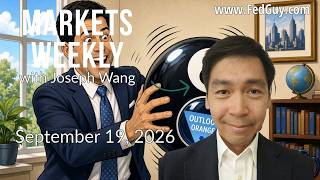
Joseph Wang, on Fed Guy, put the same conclusion in a wider frame. With September option expiry behind it, he argued, the market "is going to have more freedom to move", and what moves it is the Middle East: a positive resolution and "S&P 500 is going to go to 8,000 in the blink of an eye", an escalation and "you could have oil surge, yield surge". He named the mechanism that makes resolution hard — it "will require the president taking a loss" — and left the direction unresolved rather than picking one.
The consequence is a timing asymmetry. The truce holding through this week is close to fully priced, so there is little left to win from it. The repricing risk sits in the legs that are cheap because they are far away, and the weekend gave the market a reason to move them.
2A hike moved out of October and into the tail rather than off the board
The Fed delivered its increase on 16 September and the effective funds rate stepped from 3.63% to 3.88% on the 17th, its first move up in three years. The trigger was in the August CPI print: the headline index rose 0.40% on the month and stands 3.35% above a year ago, against core CPI at 2.45%. Core PCE, reported through July, runs at 3.34%. Unemployment is 4.1% and August payrolls added 162,000, so the labour side gave the committee no reason to wait.
What happened next was not a repricing of whether more follows, but of when. Polymarket's October contract now prices a 25bp increase at 54.5%, down 1.0 on the day against 43.5% for no change, on $27.2k of 24-hour volume and $747k of liquidity. Over the same day, the contract asking whether any further hike lands in 2026 rose 3.0 points to 86.5%, and the leg for three hikes in the year gained 2.25 points to 26.4% while the exactly-one leg fell 1.0 to 15.5%. October got marginally cheaper; the tail got dearer.
Kalshi's board did not move on price, which is what a weekend looks like, but it did move on size. October hike-25 last traded at $0.54 against $0.54 a day earlier, and hold at $0.44 against $0.44. Open interest on the hike leg rose from 266,606 to 281,326, and on the hold leg from 407,528 to 414,173 — roughly 14,700 contracts added to the hike against 6,600 to the hold. December is steadier and higher: hike-25 at $0.67, hold at $0.30, both unchanged.
The cash curve agrees on direction. The ten-year yield printed 5.01% on 16 September and 4.94% on the 17th, and the gap between two-year and ten-year yields compressed to 0.25 points on 18 September from 0.27. A flattening curve alongside a rising front end is a market pricing more policy, not more growth.
Andy Constan, of Damped Spring Advisors, speaking on Excess Returns, called the decision "a no-brainer" and located the reason in Chair Warsh's own positioning: he "went all in on being an inflation fighter", which "paint[s] yourself into a corner when data comes in hot". Constan's more checkable claim is about the gap between the three forecasts now on the table. The committee's dot plot carries one more 25bp increase this year and then a flat 4.125% through 2027; "the bond market's already another 50 basis points more hawkish than that", he said, with roughly 75bp of hikes priced forward. The event markets sit closer to the dots than to the bond market on the 2026 count — a 60% chance of exactly two hikes in the year means one more, no more. These are not the same horizon, so they are not in contradiction: the dispute is about 2027, where no contract on either venue trades.
He also put a second policy lever in the frame, pulling the other way. The Treasury has roughly doubled its buybacks, adding $75–100bn against $928bn of annual coupon issuance, up from a $64bn base. Constan's estimate of what that is worth is deliberately small — "five or 10 basis points max" — but he notes it is stimulative and therefore at cross purposes with a committee trying to return inflation to target. The next issuance and buyback plan is announced on 5 November, the Wednesday after the midterms.
The consequence is a six-week vacuum. The next scheduled decision is 28 October, and until then the only things that can move the October leg are data and the long end.
3The case for owning bonds again rests on the one leg its own advocate says fails
Constan laid out four conditions for owning long bonds and marked three of them passing. The risk premium to cash is around 100bp of expected excess return on ten-year notes, which against roughly 6% annualised price volatility is a Sharpe ratio of about 0.17 — "not great", in his words, but set against the summer of 2020, when the same calculation was negative. The real yield of about 3% compares against long-run growth expectations closer to 2%, even with GDPNow running at 5.1% this quarter, so buying here is a bet that "short-term growth is overstated relative to the long-term growth". And the capital-appreciation condition is met for the first time in years: from a five-handle, a move to 4% or 3% "you're going to have substantial capital appreciation in a bond portfolio, and you're going to need it, because equities are going to fall".
The fourth condition is inflation compensation, and he marked it down. Breakevens of "basically between 2 and 2.5%" are "not much", and he said so directly: "that one's a concern, particularly if inflation reignites". With headline CPI at 3.35%, that is the leg carrying the weight.
Attaching the caveat to the call changes what the call is. On Constan's own framing this is not an inflation hedge — it is a growth-disappointment hedge that happens to be cheap, and it works only if the Fed does what he separately doubts it will do. His conclusion is a portfolio one rather than a directional one: the 60/40 goes "from being worthless to being a much better formulation" than pure equities, held alongside commodities and gold. He was explicit that this is about which betas are investable, not a call that bonds are a screaming buy.
The same logic is what took him abroad. He described buying into developed markets outside the US around the inauguration, once foreign bond yields backed up far enough to be worth owning — "if your bond market is uninvestable, chances are your currency is going to depreciate", and a stock market with no domestic hedge underperforms. He named the developed-ex-US fund as the way to look at it, and said it has doubled the S&P's return since the inauguration. He is now looking to overweight Japan specifically, and he attached the qualifier himself: "I'm not advocating buying Japanese stocks over US stocks. I'm advocating buying Japanese stocks and bonds over US stocks and bonds."
That qualifier is load-bearing, and it is where Wang's read collides with it. Wang argued the interest-rate differential still points the other way for the currency: the Bank of Japan hiked to 1.25% but two appointees of Prime Minister Takaichi dissented, the yen weakened on the announcement, and the market prices about two more BoJ hikes against three more from the Fed. On his reading that "argues for further dollar strength, yen weakness", which is a drag on exactly the translation Constan is relying on. Both were published the same day. Neither addresses the other.
4The near-term variable for the data-centre buildout moved from funding to politics
Two separate sources put AI regulation on the political calendar this weekend, from opposite ends of it.
The President posted on Saturday afternoon that the attempt to bring about "the decimation, or destruction, of AI" is a hoax, and that the administration "will not in any way hinder or stifle the Growth of this incredible Industry". The post commits to an "AI Force" modelled on Space Force, promises to name an AI "Czar", and sizes the industry at "possibly as much as 25% of our Country's GDP". It names no company. A second post, early Sunday, praised an interview on the same theme.
Wang, publishing hours later, named the risk the post is answering. After the midterms, he argued, "there is a possibility that you could have a blue tsunami", and the leading candidates he is hearing are "a bit more wary of the AI data center buildout and a bit more pro-AI-model regulation" — which "could have big impacts on the AI trade". That is a dated catalyst on a policy variable, and it is the one he flagged for the coming weeks alongside the Middle East.
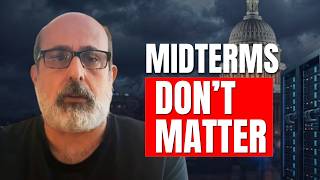
Constan supplies the third leg and disagrees with the framing. He treated the safety-slowdown story around Anthropic as unresolved — "supported ultimately by multiple players and then criticized by others" — and argued the mechanism that matters is funding, not politics: companies are "buying back less stock, issuing more stock" to meet capex expectations, and a slowdown from any cause "is bearish stocks full stop", because the hit to earnings expectations swamps the relief from lower issuance. He also said the midterms themselves "don't matter", because no plausible outcome either unleashes or removes the President's power, leaving what he called gridlock either way. On his list, what matters is Iran, the funding of capex, whether the capex pays off, and whether the Fed acts on inflation.
So one source says the political turn is the risk to the AI trade and another says politics is noise and funding is the risk, and the administration has pre-committed against the first. The consequence is that the buildout now has two distinct failure modes with different tells: a capex slowdown shows up first in issuance and guidance, a political one cannot show up before November.
What the sources recommended
Two videos produced one single-name call between them, and it came attached to a qualifier that changes it. Andy Constan, on Excess Returns, named , the developed-markets-ex-US fund, as the expression of moving beta outside the United States, and said it has doubled the S&P's return since the inauguration. The qualifier is his own and it is not optional: he is "not advocating buying Japanese stocks over US stocks", but Japanese "stocks and bonds over US stocks and bonds" — a whole-portfolio switch, not an equity preference. Auto-captions rendered the symbol as "VA"; the instrument he described is unambiguous, but the letters are not what he said.
There were no sell calls on either video. Anthropic came up on Excess Returns only as an unresolved news story about a safety-driven slowdown, with no view expressed either way.
The weekend's news gets its first price at Monday's open
Everything in the first claim is untested until 09:30 ET on Monday. The strike on Riyadh, Beijing's intervention with Tehran, and the Turkey-Saudi defence pact all landed after Friday's close, and crude's cash market was shut for both. The first mark on the escalation-versus-de-escalation question is the open, not a headline.
The rate path has a longer wait. The next Fed decision is 28 October, the next Treasury issuance plan is 5 November, and no scheduled release between now and then carries the weight of the August CPI print that triggered this hike.
The week's earnings are thin and domestic: AAR on Monday, AutoZone, Ferguson, Thor Industries and KB Home on Tuesday, Cintas, Paychex and H.B. Fuller on Wednesday, and Costco, Darden and TD Synnex on Thursday. The homebuilder and the auto-parts retailer are the two that read directly on the consumer Constan described as funding consumption by drawing down savings and borrowing against appreciated assets.