1The AI bear case moved from demand to debt
The dominant thread across the day was a shift in what the AI sceptics are actually worried about — no longer whether the demand is real, but whether the financing structure behind it can hold. Ross Givens, in a video titled "Sell This AI Stock NOW," argues that if an AI-infrastructure bust comes it will be a capital-structure event, not a demand event: the lenders move first, and without warning. His template is 1999, when Lucent lent roughly $8bn to its own customers and booked it as revenue — and when it finally declined WinStar's next $90m, a $6.3bn company was in Chapter 11 in eighteen days. He maps five modern analogues: (CoreWeave) as Exodus, and as WinStar, as Williams, as Global Crossing, and itself as Lucent — the vendor underwriting its own demand.
The specifics behind those labels are the argument. borrows at 15%, 12% and 11% across facilities to earn roughly 1% on the proceeds, with $11.7bn of debt due by year-end against $2.2bn of cash. booked $44.8m of revenue last quarter against $56m of interest expense — it paid its lenders more than it took in. has zero revenue and no binding customer agreements, $27m of cash, and yet spent $441m on construction in a single quarter, while all eight covering analysts rate it a buy.
Felix, on Felix & Friends, reaches the same place from the credit side: 's debt doubled this week while the stock sits at an all-time high, and the cost of insuring that debt against default has doubled in a month. His structural point is that the buyback bid has flipped — the hyperscalers (, , , , ) net sold about $147bn of their own stock this year, against roughly $190bn of buybacks two years ago, so the decade's most price-insensitive buyer is now a seller. His own book leans the other way: he disclosed buying , an international quality-factor fund built to hold almost no US mega-caps.
Mark Zandi, on Prof G Markets, supplies the mechanism that makes the whole thing pro-cyclical. Neo-cloud debt is collateralised not by the GPUs but by customer contracts, and as hyperscalers pull back from signing them, keeps having to backstop the borrowing itself — the same circular financing, described from the macro seat. The through-line across three very different channels is one claim: the risk in AI infrastructure now sits on the balance sheet, not in the order book. What none of them will give you is timing — Givens is explicit that "the music is still playing," and structures like these can run for years. (The ten further short-form uploads in the day's feed were re-cuts of these same episodes, not independent voices — the corroboration here is three channels, not thirteen.)
2The September rate hike is bleeding out, but a cut this year is still a lonely call
July CPI landed in line and payrolls printed negative, and the market read both as removing the last trigger for a September hike. Polymarket's September Fed contract — the deepest on the board at $31.6m of volume — now prices no change at 70.5%, up four points on the day, and a 25bp hike at 28.5%, down five. A couple of sessions ago the hike side was near 40%. The debate is still hold-versus-hike; a cut is not priced for September at all.
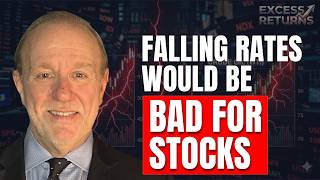
That makes the call from Jim Paulsen, on Excess Returns, the contrarian one. Across 34 charts he argues sentiment is turning from inflation-fear to growth-fear in the back half of the year, and that the Fed will be cutting before year-end — the labour force rolling over, participation down 1.1 points from its high, real personal income ex-transfers −4% year on year, the saving rate at a record low. But the market disagrees with him twice over. The same Polymarket board still prices a 2026 rate hike landing somewhere this year at 53.5%, better than even — the precise opposite of a cut. One of them is badly wrong. And Paulsen hedges his own tail: his case is for "a growth scare, not a recession," which is why the recession contract is drifting down to 8% rather than up, even after the negative payrolls print.
3The rally broadened beyond big tech, and the sources can't agree what that means
The one straightforwardly bullish read of the week came from Equity Mates: global earnings season was strong and broad, with 88% of the S&P 500 reported, STOXX 600 earnings growth of 22%, and the DAX, FTSE 100, CAC 40 and IBEX all at record highs. Their framing is that this is not just a big-tech rally — the equal-weight S&P 500 is beating the cap-weighted index, so breadth is doing the work. They spent a segment rejecting Michael Burry's disclosed short book — , , , and among the names — pointing out that his short ran straight into a record quarter, revenue over $20bn, profit up 65%, the stock up 100% in a year.
Jim Paulsen reads the same breadth as the tell, not the health. His correction call is deliberately concentrated: a full S&P pullback beyond 10%, centred on the "new era" of tech and communications, while the other nine sectors hold up — which is what a rotation out of the leaders and into the laggards looks like on the way down, not up. So the same fact, money leaving the mega-caps, is either the market getting healthier or the market rolling over, depending on whose frame you take. The tape can't settle it yet, which is exactly why it is worth watching.
What the sources recommended
Eight names on the sell side against a single buy — and the sells are one thesis, not eight independent calls.
The sells. The AI-infrastructure credit names carry straight over from the first section: , , , , and from Ross Givens' 1999 map, plus (Archer Aviation, burning cash with insiders selling and none buying) and (Cameco, flagged for shareholder dilution and a heavy earnings miss) from Felix. Read the credit names as one call on financed AI rather than a basket of separate shorts.
The buy. — Felix's own disclosed purchase, an international quality-factor fund built to hold almost no US mega-caps. It is the mirror image of the sell list: out of financed US tech, into ex-US quality.
The clearest test of the AI-capex read lands after tonight's close
(Applied Materials) reports after the close — the day's largest print and the cleanest read on AI-capex order flow, which is the exact thing every bear in the first section is betting turns down. July PPI prints into the session with Treasury yields already dipping ahead of it, and weekly jobless claims land alongside. If the order book is still accelerating, the balance-sheet worry stays theoretical a while longer; if it rolls, the financed names in the first section are where it shows up first.