1The chip complex lost about $1trn in a week without an earnings miss behind it
Scott Galloway and Ed Elson, on Prof G Markets, argue the semiconductor drawdown was mechanical rather than fundamental. , and all reported fine. The complex still shed roughly $1trn of market value in a week, and the selling came from leverage being unwound rather than from estimates being cut.
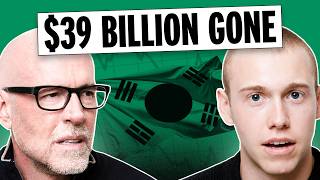
South Korea is their case study, and it is recent enough to still be settling. The KOSPI fell 22% in a week, bounced 15% within days, and now sits about 44% below its high — roughly $2trn of market value gone, with Samsung down 32% and SK Hynix down 40%. The cause they identify is a batch of single-stock leveraged ETFs listed in late May, offering 2x, 3x and 5x exposure to those two chipmakers. 92% of the holders were retail. Goldman Sachs estimates that 3.4% of South Korea's adult population has taken a margin call, with retail losses of about $39bn. The regulator has stopped approving new listings.
The read-through they draw is that the US has the same structure a few months behind. Leveraged-ETF assets went from $120bn in April to over $200bn now, a 70% rise, and more than half of that sits in single-stock funds. One blow-up has already landed: the Situational Awareness fund run by Leopold Aschenbrenner was up 439% year to date at 5x leverage, was margin-called, and liquidated its entire public book to a single buyer, Citadel — longs including SK Hynix, shorts including . Galloway's stated expectation for August is "half a dozen" further headline forced-selling events. This was one of only two subjects that came up in two different episodes on the day; the other was how the AI build-out is being financed.
The consequence is a reading problem. If the marginal seller in a crowded name is a margin desk, the size of a down day tells you who owned it with borrowed money, not what it earns.
2Big tech's reported profit leaned on marks to private stakes, and the spending behind it is now borrowed
The price reactions sorted the quarter on a single axis: whether a company could show AI revenue. rose 16% on cloud growth of 43% and 30 million Copilot seats, and rose 14% on AWS growth of 37%, its fastest in five years. fell 8%, with free cash flow down 91% to $784m and no monetisation answer, and fell 7%.
The number Prof G Markets pulled out of the filings complicates that. $53bn of 's $63bn of net income was its Anthropic stake, and 87% of the combined net income of and traces to marks on Anthropic and SpaceX. Adjust for the venture marks and Amazon trades on 30x rather than 19x, and Alphabet on 31x against a 12x headline. Both are now free-cash-flow negative, while guiding capex to $220bn and $205bn respectively; guided $145bn and $11bn.
Ben Hunt, on Excess Returns' Weekly Wrap, supplies the funding side of the same picture. He frames AI capex as World-War-II-scale on an inflation-adjusted basis, roughly one point of the ~2% GDP growth rate, and the multiple-driver for the past eight months. The money has shifted from cash flow to debt and equity issuance — Alphabet is free-cash-flow negative and is both borrowing and selling stock — and the lenders are private credit, private equity and the alternative managers, not the commercial banks. His conclusion is the sharp part: stepping off this treadmill would not be a bear market but a financial-system event, because the balance-sheet risk sits with the shadow banks. He adds a transmission channel into rates, in that governments and hyperscalers borrowing trillions simultaneously against a structurally smaller pool of capital keeps the cost of capital rising for other borrowers.
The quarter that looked like proof the spending pays for itself is also the quarter it stopped being paid for out of cash flow.
3September still prices a hike, and the July hold pushed the ten-year up 7bp
Polymarket's September Fed contract puts a 25bp hike at 55.5%, down three points on the day, on $336k of 24-hour volume — the most liquid leg on the board. No change is 42.5%, up two, and any cut is around 1%. The live argument is hike versus hold; easing is not in the price. The deeper-dated 2026 rate-hike contract reads 67.5%, but on $64k of 24-hour volume against $6.2m of lifetime volume, so it is stale and September is the signal to watch.
The bond market's read of last week's hold points the same way. The daily effective fed funds rate was flat at 3.63% through 30 July, confirming the hold, while the ten-year rose 7bp across the meeting to 4.68% — a hold taken hawkishly. The two-year/ten-year spread widened slightly to 0.47, steepening without inverting. The hawks' arithmetic sits in the real rate: a 3.63% policy rate against core PCE running 3.29% year on year is barely restrictive, and core is not falling the way headline is, with June core PCE up 0.13% on the month while headline CPI fell 0.42%.
Rupert Mitchell, on Excess Returns, explains why this is even a debate. Last week's FOMC ran into 31–36% odds of a hike on the day, which he calls unprecedented for the forward-guidance era and a direct product of Warsh scrapping both guidance and a stated reaction function. His "death shot" framing is that cycles usually end on a deliberate last-hike-too-far, and that Warsh has little room, because the data-centre boom and the private-credit complex both finance at the front of the curve. That is where this section meets the last one: the front-end volatility a guidance-free Fed creates lands on the exact part of the curve the AI build-out borrows at.
4Crude fell 5% on two separate legs, and only one of them can reverse on a headline
Crude fell 5% to a three-week low after Trump called off the planned strike on Iran, and equities rallied on it. The de-escalation is asserted by one side and denied by the other: Iran says publicly that no talks are under way and that it is dealing only with Oman. Trump's own posts carry the same ambivalence — on 2 August the US was "locked and loaded" but holding off because "the perimeters of a deal" had been agreed; on 3 August he called Iranian leadership "unbelievably duplicitous" for denying the talks exist.
The prediction market sided with the tape. Polymarket's effective-ceasefire contract for 14 August rose five points to 69.5%, on $58.5k of 24-hour volume against $734k lifetime, and the 31 August leg rose four points to 75%. Both legs went up while crude went down, which is corroboration rather than contradiction — though on a book that size it is weak corroboration.
The second leg has nothing to do with any of that. OPEC+ agreed a September output increase that completes the rollback of its voluntary cuts, which is a supply event no headline reverses. The administration is pushing the same way at home: the Department of Energy directed Sable Offshore to restore the Santa Ynez unit and its pipeline, and Trump spent an interview praising 's results and posted that "Oil Exports are SURGING". A ceasefire the two sides describe differently can be repriced in a morning; a completed OPEC+ rollback cannot. What survives either way is the Strait of Hormuz — one forecaster warned the UK faces recession if it stays closed, and the ECB said the war hit euro-zone consumption especially hard.
5Tesla's margins collapsed in a record delivery quarter, and the merger case rests on an unverified probability
Ross Givens lays out the quarter behind the selloff: record deliveries of 480,000, up 25%, on $28bn of revenue, against an operating margin that fell from 4.1% to 1.4%. Free cash flow went negative with over $1bn burned, operating expenses rose 47%, capex is guided at $25bn with a further $30bn of planned borrowing, and the Model S and X were killed to free floor space for humanoid robots. had its worst July on record — down 28% on the month, down 32% year to date, with $261bn of value lost in six sessions.
His explanation is incentive rather than sabotage. Musk owns 42% of SpaceX and more than 80% of its votes through ten-vote class B shares, against 19.9% of Tesla on one-share-one-vote. In a stock-for-stock merger, a cheaper Tesla hands him a larger slice of the combined company, and he sits on both sides of the exchange ratio. The board's alternative route is stalled meanwhile: the first tranche of the 2025 pay package needs a $2trn market cap against today's $1.2trn, so the stock has to rise about 65% before he earns a single share.
The number the thesis turns on does not survive a check. Givens cites a 74% prediction-market probability of a merger before May 2027. Polymarket's comparable contract prices an announced merger by 31 December 2026 at 17.5%, with the 30 September leg at 4.2%, though on $49 of 24-hour volume that is a thin book in its own right. A different venue and a longer horizon explain part of the gap, not all of it. The margin collapse is in the filings and needs no thesis; the merger probability is unverified, and the 14-minute video ran a paid-membership pitch twice.
6Cropland grows five times slower than the population, and the interesting agtech is private
Equity Mates' Decade Ahead series set out the arithmetic. Global agricultural output is $3.5trn heading to about $4trn by 2034, a 14% rise, while cropland grows 0.14% a year against population growth of 0.7%. On those numbers the whole increase has to come from yield. Two things changed recently enough to matter — Starlink connectivity reaching remote farmland, and AI making sensor data actionable. The gains they quantify are large: precision agriculture lifts yields 20–30% and cuts input waste 40–60%, targeted robotic spraying cuts herbicide use by up to 90%, and individual CRISPR-edited corn traits add 10–26% of yield each. The stated brakes are cost and weather — weeding robots run to $250k and autonomous tractors start at $500k, and the recent olive oil, cocoa and coffee shortages show what weather does to the commodity side.
The four operators they found most interesting are all private: Halter in New Zealand (smart cattle collars, $315m raised at a $2.9bn valuation), Exsightes Digital in Western Australia (livestock ear tags), SwarmFarm Robotics in Queensland (autonomous weeding) and CropX in New Zealand (farm data). The listed map — , and on machinery and precision, and on seeds and crop protection, plus the , , and ASX-listed ETFs — was presented as where the theme is investable rather than as what to own, and those ETFs converge on much the same large-cap names. Two disclosures travel with the episode: the series is sponsored by ANZ, and Equity Mates Media sits inside the BetaShares group while the episode names the BetaShares ETF, disclosed in the closing legal read. The exposure available on-exchange, in other words, is not the exposure the theme describes.
What the sources recommended
Three single-name calls came out of the day's four episodes, and all three came from one of them — with the two hosts openly disagreeing about one.
The buys. is Prof G Markets' 2026 pick among big tech, on AI in industrial robots plus the warehouse moat, with retail revenue seen doubling by 2033 without incremental hires. is Ed Elson's own long, called bottomed at 20x against 31x in January 2023 — a disclosed position rather than a detached call, and the same episode notes the 91% free-cash-flow drop behind the 8% fall.
The sell. , at 38x earnings against 21x in January 2023, which Elson reads as a premium paid purely for sitting out the AI capex race, with no visible growth path beyond a 20%-share iPhone franchise, a flopped headset and a cancelled car. His co-host Scott Galloway disagrees on air and holds the stock, so this is a contested call rather than a house view.
Two positions that are not calls. is held from $400 and $380 and up 20%, with no fresh entry suggested. is a decade-long bull case its author is not acting on: Givens wants the $50s before entering, restating his 30 July stance of avoiding it above $60. The agriculture names above are also not logged as calls — they were framed as an exposure map, and one host said he owns none of it.
The hike case and the AI-earnings case both get tested this week
reports after today's close, the session's single biggest scheduled catalyst, with , , , , , , and later in the week and , , , , and on Thursday. Then come the two macro prints the September hike case has to survive: Friday's July employment report, and July CPI on 12 August. With the policy rate sitting barely above core inflation, those two numbers decide whether the hold at 42.5% or the hike at 55.5% was the right side of the contract.