1AI capex is paying the bottleneck, not the buyer — and a cheap chip multiple is the tell
Andy Constant, on Excess Returns' Last Call, framed the AI trade around a constraint the growth arithmetic has to fit inside. Nominal GDP is a fixed pie, and the number of companies whose share prices already assume enormous earnings growth is larger than that pie can feed. Under that frame the hyperscalers are the ones spending — they buy a slice, they do not eat one. The semiconductor names have outperformed them because they do eat. But eating is not the same as keeping: chipmakers hand much of what they earn straight back out as capital equipment. The group Constant calls the "Fab Five" — , , , and , with Tokyo Electron alongside them — sits at that bottleneck and gets paid out of the capex the layer above it spends.
The counter-example does the analytical work. trades on a cheap multiple, and Constant reads the cheapness as the warning rather than the discount: memory has no moat, the business is a boom-bust cycle, and the earnings that make the multiple look low get spent on the capacity that ends the cycle. His caveat belongs with the call — this is a caution, not a sell, and he separates it explicitly from , which he says does have a moat.
So the pie frame turns a screen upside down. Within one sector, in one week, a low multiple is read as evidence of the cycle rather than of value, and the durable margin is claimed to sit with whoever sells the constraint rather than whoever owns the demand.
2The SpaceX listing drained the small space names, one of them straight through a fivefold order book
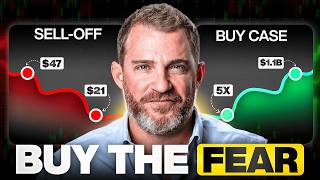
(Intuitive Machines) fell from $47 to about $21 in a month. Ross Givens attributes it to three things landing at once: the gravity effect of the SpaceX listing pulling capital out of the other listed ways to own space, a Blue Origin explosion, and a $500m share offering that diluted holders. None of the three is a demand event. Over the same stretch the backlog went from $213m to $1.1bn — five times — on a new $148m NASA lander award and a $4.8bn multi-year NASA communications and navigation contract. Last quarter's revenue was $186m with a small adjusted operating profit, against full-year guidance of $900m to $1bn. Cantor moved its price target from $26 to $43 at overweight.
What he is actually trading is a landing and a squeeze. The IM3 mission lands later this year, and because the first two Intuitive Machines landers tipped over, the third is the proof point. Short interest sits near 35%, the same setup that took from under $14 to over $17 in a session earlier in the week. His levels are as explicit as the call: a retest of prior acceptance around $19-20, with $16-17 the line in the sand and $8-10 the downside if it breaks. Two caveats travel with it — the episode carries a paid-service plug, and the stock's own average daily range is above 10%, which is his figure, not a critic's.
The same listing turns up in Constant's episode as a hazard rather than an opportunity. He spent a segment on the index-flow game around the SpaceX addition to the NASDAQ, expected around 7 July, and his conclusion is that "40-chess isn't real" — passive flows around index adds are not reliably predictable, so positioning for them is not the free money it looks like. The two are not flatly contradicting each other; one is about the wreckage around the listing, the other about the listing's own flow event. But they cut in opposite directions for anyone who assumes the space complex reprices in a knowable order, and Monday's reopen followed by the index add is where they separate.
3The bull case now rests on breadth rather than on seven names, and the expected pace comes down with it
Brian Belski, on The Compound and Friends, is still bullish with an S&P 500 target of 7,000 — but the shape of the bullishness is the news, not the number. He describes a market that has stopped being driven by momentum and started being driven by earnings, which he puts at roughly 10-12% annual returns rather than the 20-25% of the momentum years. His warning line is "beware the second-derivative less positive": the direction holds, the rate of improvement does not. The breadth call follows from it — performance widening out of the seven mega-caps into value, dividend growth, and small and mid caps, held as a barbell rather than traded as a rotation.
Two single names sit inside that frame. is "one of my favorites," a position he moved into out of years ago; is a buy candidate for his value portfolio. On itself he is genuinely split, calling it "the best user of AI on earth" for generating revenue while noting the capex spin-up and that it has been giving back gains. He is bullish financials and specifically regional banks, on cheap multiples and mid-size consolidation. And he flagged AI-infrastructure names and as going down, which in his telling is a symptom of the rotation rather than a call on either. One disclosure belongs alongside all of it: the episode carried a disclosed sponsor read for a quantum-computing fund, , which is an advertisement rather than anyone's recommendation.
The consequence is a harder tape to be right about than the one it replaces. An index can keep climbing while the engine that lifted it stalls, and a call on the index level stops being a call on the same thing.
4The Fed's credibility recovered faster than its inflation did, and both sides of that argument end up at gold
Ben Hunt, of Epsilon Theory, brought the Fed-credibility data to Last Call. The narrative bottomed at an all-time low around 30 June 2025, in the depths of the Trump-versus-Powell fight, and has since flipped to net-positive. His caveat is about the derivative rather than the level: the rate of change is unsustainable, and he ties the same measure to repatriation flows and to the peak in gold.
Felix, on Felix & Friends, reads the same institution and arrives at the opposite conclusion, via three moves he argues are already in motion. The new Fed chair, Kevin Warsh, is promising 2% inflation while it runs closer to 4%. The GENIUS Act's stablecoin regime obliges a 140-company consortium — Visa, Mastercard, American Express, BlackRock, Google and Coinbase among them — to hold US Treasury bills against its coins, manufacturing demand for government paper. And an explicit devaluation policy, associated with Stephen Miran and the Mar-a-Lago Accord, sits behind both. He calls the result financial repression, with holding cash the losing side of it, and his framework is categories rather than tickers: real estate, gold, quality businesses with pricing power — 's 17% price increases are his illustration — and the payment processors and exchanges that clear stablecoin flows.
Handle that one with tongs. The episode is heavy lead generation, with a free workshop pitched roughly six times, a paid app trial, and fear framing down to "your portfolio is broken by end of July." The direction of the argument is reported here; the specificity is not corroborated. What is striking is that the two channels agree only on the destination: Hunt reaches gold as a peak signal, Felix reaches gold as the hedge. Same asset, opposite trades, and central banks are hoarding it at the fastest pace in decades either way.
The near-term inflation input cuts against the panic. Brent Kachuba, on the same Excess Returns episode, walked the oil side: Hormuz still carries about 11% of the world's oil and is still the choke point, but Iranian supply is flooding the market, and his rule for cutting through the narrative is that "the crack spread does not lie." With the Doha talks concluded, Kuwait and the UAE at record output, and Chinese refiners buying discounted Middle Eastern crude, the energy contribution to inflation is softening now, whatever the monetary argument says about later.
What the sources recommended
Eight buy-side names came out of four videos, and five of them are one group thesis rather than five separate calls. Neither sell-side entry is actually a sell.
The buys. is the only explicit, priced, time-bound call of the day — Ross Givens', with the levels, the landing catalyst and the paid-service plug detailed above. , , , and are Andy Constant's "Fab Five" bottleneck thesis on Excess Returns, offered as a place in the value chain rather than as five names, with no price and no timing attached. and are Brian Belski's on The Compound and Friends — the first a long-standing favourite he has held for years, the second a candidate for his value portfolio, both months-horizon views inside his breadth call rather than fresh initiations.
The sells. Constant's is a caution and he says so: cheap multiple, no moat, capex eating the earnings. Felix's is not a company at all — it is cash as an asset class, "an ice cube on a warm counter," which is a position on the dollar rather than on any business.
Monday's reopen runs straight into the index add that reset the space sector
US markets reopen on Monday 6 July, Friday 3 July having been the observed Independence Day holiday, and the SpaceX inclusion in the NASDAQ lands around Tuesday 7 July. That is a large passive-flow event and the direct test of the disagreement in the second section; the listed space complex, and among it, is where it shows up. The week arrives with little to lean on: June payrolls, released on 2 July, came in well below expectations and the dovish read carries forward, but Monday's earnings calendar holds closed-end funds only, and Q2 season does not begin in earnest until around 17 July. On the geopolitical side the US-Iran de-escalation continues — concluded Doha talks, record Kuwaiti and Emirati output — with a NATO summit in Ankara and the Khamenei funeral week in Iran both in the frame, so crude and the refiners are where the crack-spread argument above gets marked. Running underneath it all is the collision between the White House and the new Fed chair over rates, which is the pressure the credibility data in the last section is measuring.