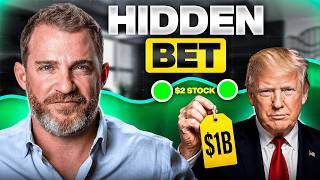
1Washington's equity-stake playbook has a repeatable sequence, and its tells now point at uranium enrichment
Ross Givens, on his own channel, argues that the US administration's habit of taking equity in strategically important companies has become regular enough to anticipate rather than react to. His count is fifteen deals in sixteen months, worth about $21bn — MP Materials () rose 338% after its Pentagon stake, and Intel () took $8.9bn. The screen he says identifies the next candidate has six conditions: a Chinese chokepoint on supply, a place on the critical-minerals list, US-based assets, a capital-spending gap the company cannot close alone, dual-use output, and a US listing. The deals then arrive in a set order — an executive order, a Defense Production Act invocation, a Department of Energy grant, an in-person visit from Lutnik, a convertible note, and finally the stake.
Most of that sequence is already on the board for the uranium fuel cycle. A 23 May executive order titled "Reinvigorating the Nuclear Industrial Base" invoked the Defense Production Act on enrichers. The Department of Energy split $2.7bn between Centrus, Orano and General Matter in January. And the waiver that still lets Russian enriched uranium into the US expires in 2028, which forces domestic capacity to be built before then. Two of the later markers have appeared as well: Lutnik attended the Centrus–Korean memorandum signing in person, as he did at MP Materials before that deal, and Centrus raised $85m of convertible notes last November — the same financing bridge MP crossed.
The three names he draws out of it sit at three different risk levels. (Centrus Energy) is the only US-owned producer of both low-enriched and high-assay uranium, a $4bn company whose chart has been consolidating between $180 and $200 after a five-fold run; his own framing is "stalking, not chasing yet". (Uranium Energy Corp) is the largest US in-situ recovery producer at 12m lb a year across Wyoming and Texas, and it spun up a domestic refining and conversion subsidiary last September to fill the gap left when Honeywell's Metropolis plant went down in 2017 — uranium spot has just printed $101/lb. (UR Energy) is the lottery ticket: a $600m company trading under $2, already up 38% this year, holding a Department of Energy uranium-reserve contract, ramping Lost Creek deliveries from 440,000 lb toward 1.2m, and carrying a capital need at Shirley Basin that would suit a government partner.
What separates the checkable part from the speculative part is timing. The executive order, the grant and the 2028 waiver expiry are dated public facts. The "90 to 100 days, maybe sooner" window for a stake is one presenter's guess, and he names two ways it fails: the Department of Energy could choose loans over equity, which is the signal Energy Secretary Wright gave on small modular reactors, or the idea gets front-run before any announcement. He also sells a subscription off the back of these calls and benefits if the names move after he makes them. If the stake never comes, what is left is a supply story with a 2028 deadline — a very different holding period from a 90-day event.
2A Nasdaq rule change, not the rocket business, is what makes a SpaceX listing a trade
Felix, on Felix & Friends, builds a 35-minute case on one mechanism. A Nasdaq rule change dated May 2026 fast-tracks low-float IPOs into the Nasdaq-100 within fifteen days, and applies a 3× weighting boost to floats under 20%. Set that against a very small free float and it manufactures demand that is not discretionary: index funds have to buy, at whatever price clears. His second leg explains why the float would stay small. Insiders borrow against their stock through securities-backed lines of credit rather than sell it, for tax reasons — the same structure Musk has used against — and Musk's own lockup runs 366 days, so on his reading the post-lockup collapse that hit Uber and Rivian is the wrong template.
The scale framing around it is much looser. SpaceX's SEC filing puts the addressable market at $28.5trn — $370bn of space, $1.6trn of Starlink and $26trn of AI that is mostly business-to-business — and the Musk pay package only triggers in full at a $7.5trn valuation, which he reads as evidence that $2trn is the floor rather than the ceiling. That is an inference about intent, not a number anyone has committed to.
The index leg is the clean expression: , which he calls the boring trade that almost certainly wins. The supply-chain names are the messy one. (Redwire) is up 163% since he named it three weeks ago and (Voyager Technologies) is up 86%, so both are reiterations of a call already made rather than fresh ones. He also pointed at Firefly Aerospace, up 69%, with no listed ticker attached in the transcript. Meanwhile the listed space complex went the other way in Monday's session — fell 14.7%, which the Yahoo markets feed read as a pullback after a run.
The short side falls out of the same thesis. Starlink Mobile, sold through a T-Mobile () partnership, is his mechanism for compressing terrestrial telecom margins, which makes , and his stated short candidates on a months-long horizon. sits awkwardly on both sides of it — the partner today, an incumbent to be disrupted later.
One caveat travels with all of it. This is a promotional video, with five or more calls to a free webinar and a research-report funnel, and the two names it holds up as proof had already moved 86% and 163% before it aired. The rule itself is dated and checkable; whether the mechanic works on the listing is the part still to be tested.
3War headlines lifted gold and aluminium while crude went the other way
The overnight tape was risk-off but shallow: US futures 0.1% to 0.2% lower, gold up 1.25%, the VIX up 1%, and Asian equities lower as Middle East anxiety offset the AI bid. Iran, Israel and Lebanon dominated the wires — a partial Lebanon ceasefire with attacks still going on, and Trump saying talks with Iran continue while confirming contact with Hezbollah through intermediaries. Aluminium hit a four-year high on Middle East supply risk.
Crude did not follow. Oil slipped on that same "talks are ongoing" line, US crude exports hit a record high in May, and OPEC+ looks set to raise its July target — three separate offsets against the Hormuz premium, with a Norwegian strike threat from 5 June covering about 8% of that workforce pulling back the other way.
The wires could not settle the direction either. Benzinga ran "S&P futures rise as US undertakes strikes" while TradingView ran "Pre-markets turn south on news from Middle East" — same session, opposite readings. Where the conflict is being priced with more conviction is in the cost line rather than the commodity: was flagged on higher jet fuel if the conflict drags on. Until either the diplomacy or the extra supply breaks, this headline risk keeps landing in metals and volatility rather than in the oil price.
4The AI trade stopped moving as one block
Inside a single session rose about 10%, 7.84% of it before the open, while fell 9%. Both are chip designers levered to the same demand, and the split is the point: the narrative is still bullish, but it has stopped paying every name inside it.
The clearest fault line runs through Nvidia's product expansion. entering the Windows laptop market is bullish for and bearish for and on exactly the same event, because it puts the accelerator vendor on x86 turf. joined the $1trn club on memory demand. , and rose on AI PC launches, so the buildout is paying the hardware channel too. And Nvidia's GTC event named Anthropic and OpenAI as customers for its Vera chip, with Anthropic itself reported to be moving toward an IPO — which would put another layer of the private AI stack onto a public tape.
Two of the day's four news feeds disagreed about one name. The Yahoo markets feed logged Qualcomm's ByteDance deal as a bullish catalyst; the Google News aggregation logged down 9% in the same window. Both can be true — a design win does not outrun a de-rating — but either feed read on its own gives the opposite impression of the same company on the same day.
What the sources recommended
Nine single-name calls came out of only two videos, and both videos sell a product alongside the calls: a free-webinar and research-report funnel in one, a $5-a-year trading subscription in the other.
The buys are two theses rather than six ideas. The uranium fuel cycle carries three expressions of one anticipated-stake call — as the enrichment pure-play, as the producer with conversion capacity, as the sub-$2 lottery ticket. The SpaceX listing carries the other three: on the index-inclusion mechanic, and and on the supply chain, both already up 163% and 86% since they were first named.
The sells are one thesis three times over. , and all rest on satellite direct-to-phone service compressing terrestrial telecom margins over months rather than weeks, and the whole of it rests on one presenter's reading of one partnership.
The AI split gets tested at both ends this week
reports today, flagged as the critical test of its Agentforce push — the application-software end, where the question is whether AI spending is showing up as revenue. reports Wednesday after the close against $22.72bn of expected revenue and $2.45 of expected earnings per share, which is the silicon end. In between: before the open at $1.94 and $11.14bn, , after the close at $0.21 and $260m, and today; and on Wednesday; on Thursday. The Yahoo day-ahead list adds and , plus continuing bank-oversight dialogue and a listing pipeline that includes Quantinuum and SpaceX — which is where the second section above gets its first real test.